Monday, November 14, 2016

Flu Shots for Work Could Save Employees from Contracting the Virus


Did you know that each year, nearly 50 million Americans contract influenza? And, that more than 100,000 people are hospitalized because of the disease, with 36,000 dying from the virus? With the flu season lasting from October to March, it’s important now more than ever to help your employees fight the virus and avoid getting sick.

Your friendly occupational medicine providers firmly believe that prevention is the best cure for the virus and would like to share with you the four top ways for you and your employees to prevent the spread of influenza in your workplace.

Wash your hands regularly

No matter what type of business or industry you’re in, you and your employees need to wash your hands regularly, especially if you frequently come into contact with a large number of people. Read more from this blog:
http://bit.ly/2fgbdMd

Sunday, November 13, 2016

Don't Fall For These Common Excuses for Failing an Employee Drug Test


Drugs are considered a menace everywhere, especially in the workplace. For employers, drug-dependent employees can lead to lower productivity and revenue for the business. It can also put employees at risk, resulting in serious consequences. To avoid these unwanted situations, many employers require potential job candidates to undergo a pre-employment drug testing procedure.

When a drug test proves positive, an applicant will naturally be asked for the reason why they failed the test. Read more from this blog:
http://bit.ly/2fEfYhc

Saturday, November 12, 2016

Take Time Reviewing Applications and Conduct Pre Employment Physical Exams


Making an applicant undergo a pre-employment physical exam before hiring is fast becoming the norm in countless industries, as many employers are seeing its advantage. More than a way to keep accidents and injuries at bay, a pre-employment physical also helps companies find the best candidates for the job.

The risk of not having a pre-employment physical exam

In a recent article, ErgoScience.com has this to say about the importance of requiring a pre-employment physical for every potential employee:

Competent background screening identifies those applicants who misrepresent their employment history, hide their criminal records and deny a habit of substance abuse – each of which is associated with shorter tenure, worse performance and increased incidence of on-the-job injury. And that goes double for employers who hire for physically demanding jobs. Read more from this blog:
http://bit.ly/2fEb8QW

Friday, November 11, 2016

Occupational Health Specialists Find Research to Avoid Slipping Injury


A slip and fall accident can happen anywhere in your operation. Depending on the severity of the accident, a fall can result in the serious injury of a worker. Such an incident can spell loss of productivity and profit, increased industrial insurance premiums, and expenditures associated with finding an appropriate replacement.

In an attempt to curb slipping/falling and the injuries that it causes, two researchers sought out a solution by taking a closer look at the helmeted guinea fowl, a bird that reacts to slips and falls similarly to humans.

Biomechanics researchers Timothy Higham of Clemson University and Andrew Clark of the College of Charleston placed the fowl on a six-meter runway and made it run either on a rough surface or a slippery one. Read more from this blog:
http://bit.ly/2fghEig

Thursday, November 10, 2016

The Need to Implement Occupational Medicine Wellness Programs at Work


Here’s a subject that’s sure to catch some attention. According to biomechanics researchers Timothy Higham of Clemson University and Andrew Clark of the College of Charleston, moving quickly with a firm-footed stance is a more effective way to walk on a slippery floor than shuffling or moving slowly.

The researchers explain that a slow approach to a slippery surface can prevent moving the body’s center of mass forward when the foot comes in contact with the surface, which is necessary to remain stable.

“The findings can be useful in helping humans, especially older ones, make their way across surfaces that are wet, icy or oily,” said Higham. “The key to avoiding slips seems to be speed and keeping the body mass forward, slightly ahead of the ankles after the foot contacts the ground.” Read more from this blog:
http://bit.ly/2fE8Rp7

Wednesday, November 9, 2016

Occupational Health Company on Ways to Prevent Workplace Injuries


An employee getting injured at the workplace can be one of the most debilitating experiences a business can face. As a business owner, you need to implement safety standards to prevent your employees from getting injured. Otherwise, you could end up losing precious time and money.

Four of the top leading causes of workplace injuries include overexertion, falling, adverse reaction to workplace stress, and being struck by an object. To reduce these types of injuries, occupational healthcare companies recommend that you uphold the following safety precautions.

Preventing overexertion

To prevent overexertion, require your workers to get help from a fellow employee when they need it. Or, supply them with the appropriate tools that they can use to assist with their tasks. You should also provide them with the necessary training to prevent instances of overexertion from occurring. Read more from this blog:
http://bit.ly/2fgd1Vr

Saturday, October 8, 2016

4 Tips from U.S. HealthWorks for Employers on Construction Site Safety


Employers are legally bound to guarantee the safety of their employees. But more than a measure to comply with law, keeping employees safe makes them more inclined to be productive. Ensuring your people’s safety makes good business sense, so it pays to implement measures that improve safety at your workplace. For those who belong to the construction industry, U.S. Healthworks for Employers would like to recommend implementing these safety measures:

Ensure safety of work areas

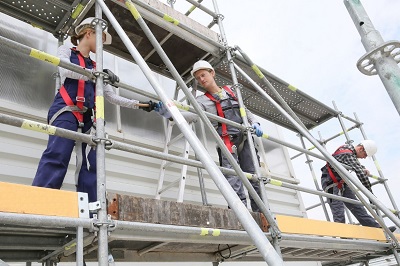
Scaffolds and ladders are associated with a lot of injuries in the construction industry. To reduce risks when working with these tools, ensure that all your people are properly trained in their use. Make sure they know the proper preparations before beginning their work. Likewise, ensure that a scaffold or ladder is properly secured before any worker climbs up on them. This is something that needs to be done at the beginning of every work day.
http://www.ushealthworks.com/blog/2016/08/4-tips-u-s-healthworks-employers-construction-site-safety/